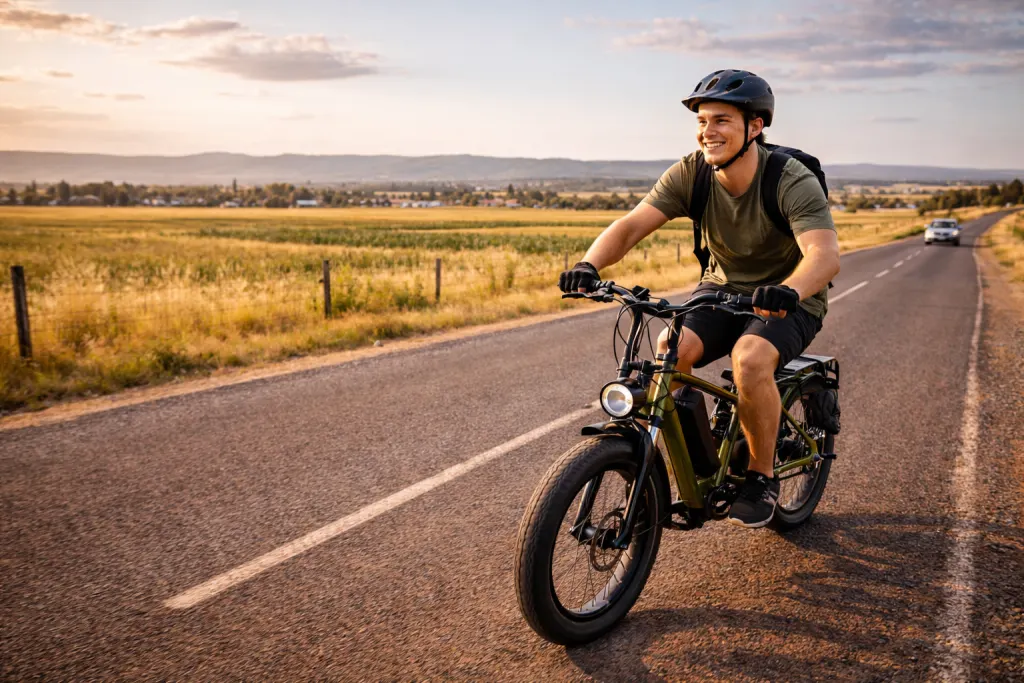
Regional and rural Australia runs on cars. The distances are longer, public transport is sparse or nonexistent, and cycling has traditionally been dismissed as impractical. But for a surprising number of daily trips in country towns, an e-bike is not just practical — it’s often better than driving.
The Case for E-Bikes in Country Towns
Think about the trips you actually make in a typical week. The school run. The supermarket. The post office. The sports ground. The pub.
In most regional towns, these destinations are within 2–8 km of home. That’s a five-to-fifteen-minute e-bike ride. You’d spend almost as long warming up the car, driving at 50 km/h through town, and finding a park.
E-bikes don’t replace every car trip — you’re not riding to the next town 40 km away for a specialist appointment. But they can comfortably replace 30–50% of the short trips that currently default to the car.
School Commutes in Regional Areas
Regional school commutes have their own character. Roads are quieter than city streets, but they may lack footpaths, bike lanes, or even sealed shoulders. Speed limits outside town can jump to 80 or 100 km/h.
Making it work:
- Stick to in-town routes where speeds are 50 km/h or below
- Use back streets and quiet roads rather than the main highway through town
- Fit high-visibility gear and lights — rural drivers don’t always expect cyclists
- For commutes that involve a short stretch of higher-speed road, assess whether a safer alternative exists, even if it’s slightly longer
For families living within the town boundary, the school commute is often the easiest trip to shift to an e-bike. Our school commuting guide covers route planning, safety, and what to look for in a commuter bike. The distances are short, the roads are familiar, and the time savings over driving (once you factor in the drop-off queue) can be significant.
Longer Distances and Range
Regional distances are generally longer than metro ones, and that matters for range planning.
Typical e-bike range: 40–80 km per charge on moderate assist. For most in-town errands, you’ll use a fraction of that. But if your daily riding includes a 15 km round trip to school, a 10 km round trip to the shops, and a 6 km round trip to sport — you’re at 30 km, which is manageable but worth tracking.
Tips for managing range:
- Charge overnight as a habit — treat it like charging your phone
- Use lower assist levels on flat terrain and save higher levels for hills or headwinds
- If your daily total exceeds 40 km, consider a bike with a larger battery or carry a spare
- Remember that cold weather, heavy loads, and hilly terrain all reduce range
Mixed-Surface Riding
Regional riding rarely stays on smooth bitumen. You might start on a sealed road, turn onto a gravel shoulder, cut through a dirt track, and end up on a concrete path.
Bike choice matters here. A city commuter e-bike with skinny tyres won’t cope with gravel. Our e-bike types guide covers hybrids and mountain bikes that handle mixed surfaces well. Look for:
- Wider tyres — 40 mm or more, ideally with some tread pattern
- A gravel or hybrid e-bike — designed for mixed surfaces
- Sturdy wheels — potholes and rough surfaces are harder on wheels than smooth city paths
- Mudguards — essential for wet gravel and dirt roads
Some riders opt for an e-mountain bike (hardtail) as a do-everything regional bike. The suspension and knobby tyres handle rough surfaces well, and they’re still comfortable on sealed roads.
The Servicing Challenge
This is the honest downside of regional e-bike ownership. If the nearest bike shop is 100 km away, getting a service or repair means a significant trip.
Strategies:
- Learn basic maintenance. Tyre changes, chain lubrication, brake adjustments, and cleaning are all straightforward and covered by countless YouTube tutorials.
- Keep spare parts on hand. Inner tubes, brake pads, and a spare chain are cheap and easy to store.
- Build a relationship with a regional bike shop. Some shops service e-bikes by appointment during visits to regional areas, or offer mail-in repair services.
- Choose a common brand. Bikes with Bosch or Shimano motors have the widest service network in Australia. Obscure brands may mean longer waits for parts. This is also why buying from a reputable retailer matters more in regional areas than anywhere else.
- Mobile bike mechanics. A growing number of mobile mechanics service regional areas. Ask at your nearest bike shop or search online for your region.
Battery issues are the one thing you can’t easily fix at home. Choose a reputable brand with a solid warranty and Australian support.
The Cultural Shift
Let’s acknowledge it: riding a bike in a country town can feel unusual. The car is king in regional Australia, and cycling is often associated with weekend recreation rather than daily transport.
But this is changing. Rising fuel costs, health awareness, and the practical capability of e-bikes are shifting attitudes — record fuel prices in 2026 have quadrupled e-bike sales at some Australian stores, with demand strongest in cargo and family models. You might get a few curious looks in the first week. By the second month, you’ll just be the person on the e-bike — and a few neighbours will be asking where you got it.
Frequently Asked Questions
Is an e-bike practical if I live on a property outside town?
It depends on the distance and the road. If you’re 5–10 km from town on a quiet sealed road, an e-bike works well for regular trips. If you’re 25 km out on an unsealed road, it’s a bigger commitment — doable for recreation, but probably not as a daily car replacement.
What about dogs on rural roads?
A genuine concern. Loose dogs on rural roads can be startling and occasionally dangerous. Strategies include: staying calm and riding steadily past (most dogs lose interest quickly), carrying a loud bell or horn, avoiding properties with known aggressive dogs, and reporting genuinely dangerous animals to the local council.
How do e-bikes handle extreme heat?
The bike itself copes fine — batteries and motors are designed for Australian conditions. The rider is the limiting factor. In temperatures above 35 degrees Celsius, ride early morning or late afternoon, carry plenty of water, and use higher assist levels to reduce your effort. Avoid leaving the battery in direct sun for extended periods, as extreme heat can reduce battery life over time.
Can I carry farm supplies on an e-bike?
Small loads, yes. A rear rack and panniers will handle a bag of feed, fencing supplies, or tools. For heavier or bulkier loads, a cargo e-bike with a front or rear cargo area extends the possibilities. But an e-bike won’t replace a ute for serious farm work — it’s a complement, not a substitute.