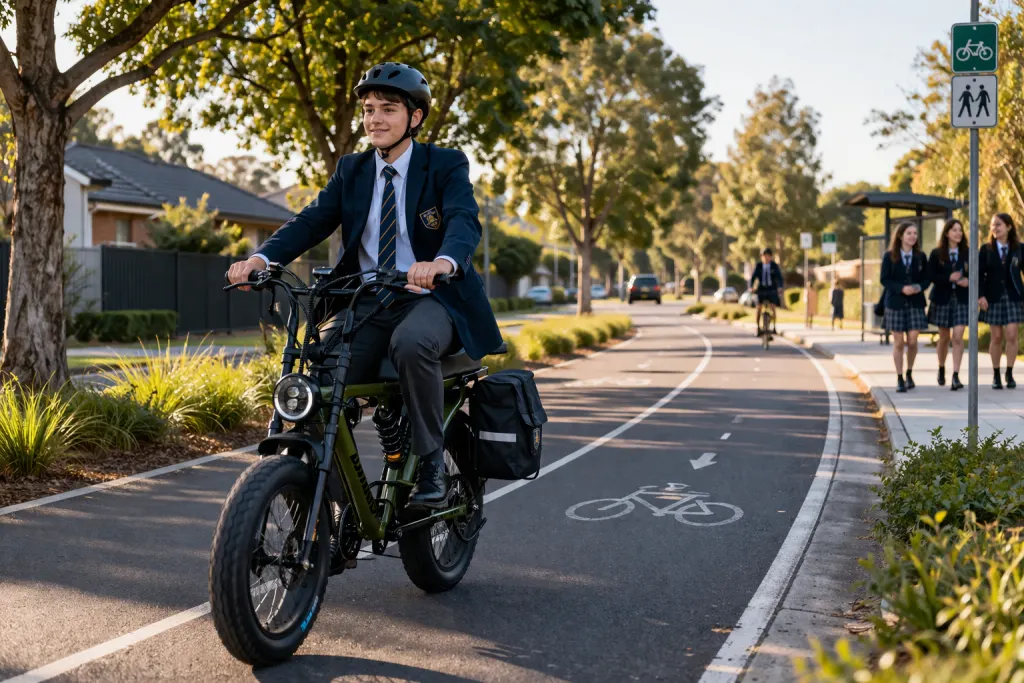
Most Australian school commutes fall between 2 and 10 kilometres — a distance that’s a bit far to walk comfortably but perfectly suited to an e-bike. For parents weighing up the options, an e-bike can replace the morning car scramble with a ride that’s quicker, cheaper, and genuinely good for your kid.
Why E-Bikes Work for School Commutes
A standard pushbike is great for short, flat trips. But add hills, headwinds, or a heavy school bag, and it quickly becomes impractical — especially for younger teenagers who might not have the fitness or confidence for a tough ride. That’s where pedal assist changes the equation.
An e-bike flattens the hills. It takes the sting out of headwinds. And it means your child arrives at school without being drenched in sweat — which, let’s be honest, matters to teenagers. If hills are a significant part of the route, a mid-drive motor makes a real difference to the riding experience.
Typical school commute distances:
- Under 3 km — easily walkable, but an e-bike makes it effortless
- 3–7 km — the sweet spot where e-bikes really shine
- 7–15 km — absolutely doable on an e-bike, though you’ll want to plan the route carefully
Even at the longer end, most e-bikes have a range of 40–80 km on a single charge. A return school trip of 20 km barely dents the battery. Our battery guide covers capacity, real-world range, and charging in detail.
Safety Considerations for Young Riders
Safety is the first thing every parent thinks about, and rightly so.
Before the first ride:
- Ride the route together on a weekend when traffic is quiet
- Identify the safest path — shared paths, bike lanes, and quiet streets over main roads
- Make sure your child is confident with the bike’s controls, especially the brakes and assist levels
- Invest in a properly fitted helmet (legally required in every Australian state)
Visibility matters. Fit front and rear lights — even for daytime riding — and consider a hi-vis vest or reflective strips on the bag. Early morning winter rides in southern states mean your child may be riding in low light.
Speed management. E-bikes in Australia are limited to 25 km/h assist, but teenagers may be tempted to push harder. Start them on a lower assist level and build up as confidence and road sense develop.
Bike storage at school. Check whether the school has secure bike racks or a locked compound. A quality D-lock or heavy-duty chain lock is essential — e-bikes are a theft target.
Route Planning With Your Child
Don’t just check Google Maps and send them off. Ride the route together at least once, ideally at the same time they’d be commuting.
Look out for:
- Intersections without bike-friendly crossings
- Stretches without footpaths or bike lanes
- Construction zones that change week to week
- Hills that might require walking the bike in early days
Most councils publish cycling maps, and apps like Strava or Komoot show popular cycling routes that tend to favour safer, quieter roads.
The Weather Question
Australia’s climate varies wildly, and rain is inevitable. The bike can handle it — your child might be less keen.
Have a backup plan. Most families find that e-bikes cover 80–90% of school days, with car or bus as the wet-weather fallback. A lightweight rain jacket and waterproof pannier for the school bag handles light drizzle. Persistent heavy rain? That’s a car day, and that’s fine.
In summer, heat is the bigger concern. The beauty of an e-bike is that higher assist levels reduce effort, so your child arrives less sweaty than on a regular bike. Encourage them to carry water and wear sunscreen.
What It Costs
Compare the numbers:
- School bus pass: $600–$1,200 per year, depending on the state
- Second car running costs: $5,000–$10,000 per year (rego, insurance, fuel, maintenance)
- E-bike: $1,200–$3,000 upfront, plus roughly $50–$100 per year in charging and basic maintenance
The e-bike pays for itself within a year or two in most scenarios. And unlike a bus pass, the bike is there for weekends, holidays, and after-school activities too. Older teenagers might even use it to earn money through delivery work.
Choosing the Right Bike
For school commuting, look for:
- A comfortable upright riding position — not a hunched-over road bike stance
- Integrated lights — one less thing to forget or lose
- A rear rack or pannier mounts — carrying a school bag on your back gets old fast
- Appropriate frame size — teenagers grow quickly, so check the size range carefully
- Reliable brakes — hydraulic disc brakes are the standard for e-bikes and work well in all conditions
You don’t need the most expensive bike on the market. A solid commuter e-bike in the $1,500–$2,500 range will serve a school commute well. For a full breakdown of what your money gets at each price point, see our spending guide.
Frequently Asked Questions
What age can my child ride an e-bike to school?
There’s no national minimum age for riding an e-bike in Australia, but rules vary by state. In most states, children under 16 can ride on footpaths, which is actually safer for school commutes. Check your state’s specific regulations — we cover these in detail in our state regulation guides.
Is an e-bike safe for a 13-year-old?
Yes, provided they’re comfortable on a regular bicycle first. E-bikes with 25 km/h limited assist are no more dangerous than a regular bike ridden at the same speed. Start with low assist levels, ride the route together, and build up gradually.
What if the battery runs out mid-ride?
The bike still works as a normal bicycle. It’ll be heavier to pedal, but your child won’t be stranded. In practice, forgetting to charge is the only real risk — a quick plug-in each evening becomes routine.
Will the school allow e-bike parking?
Most schools with bicycle racks allow e-bikes. It’s worth checking with the school administration and asking about secure storage, especially since e-bikes are more valuable than standard bikes. Some schools have designated powered bike areas.